
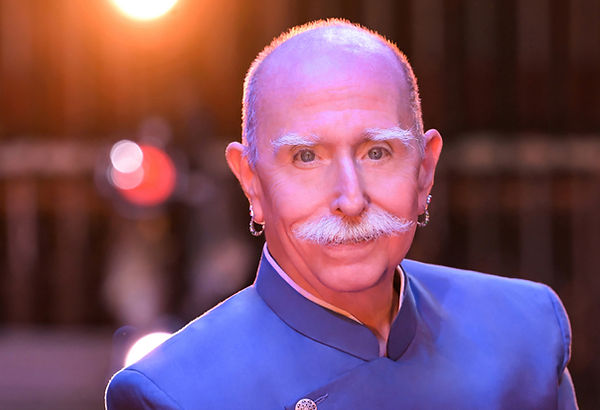

In Dance and the dP Family
It is with broken hearts that we report that Francis has passed away. He fell in his home, broke his hip, and through many complications died on December 27 at 1:10 ET. His brother Joe and Sister-in-Law Barbara were with him, and all of his beloved friends and family in the area came to the hospital to see him off. He was not alone.
Francis was born May 10, 1947 to Elvira and Joseph Patrelle. It was Mother’s Day, which neither he nor his mother ever forgot. He grew up in Buck’s County, Pennsylvania, which was mostly idyllic in his stories. He was the only Yankee fan at innumerable Phillies Games. He ate tomatoes straight from fields. He and his brother Joey played sports, ice skated, took trips to the beach and fought. And of course Francis danced. With a local girl he formed Frankie and Jeanine, the ballroom team, and even managed to dance his way onto Dick Clark’s American Bandstand. High school was mostly horrendous in his stories, so after a stint studying history at LaSalle, Francis moved to New York City and Juilliard. He studied under Sir Antony Tudor, another source of wonderful Francis stories (he called Francis ‘Philadelphia’), and he loved New York City. Loved it! He felt such kinship with its neighborhoods, its strange ways of life, and most importantly, its people.
He joined Disney on Parade after Juilliard, traveling the country as Mickey Mouse and Mowgli. At the audition he was surprised to be the center of attention. It was his height. For the first and only time, Francis was wanted for his stature. Francis hated a short joke.
Francis began his ballet teaching career in the 1970’s, and taught for more than forty years. He was the dance director at USDAN for more than a decade and taught ballet at Barnard for a brief but memorable stint in the late 90’s. But the two places he loved most were Manhattan School of Music, where for decades he taught Opera Students how to move and dance, and Ballet Academy East, where he met the wider world, and the world came to him.
As a teacher, Francis was a legend. His class was musical and challenging. It had a rhythm. A student began facing the barre - “Redefine Your Tendu’s Every Day. They are a stretch, not a point.” He never missed pas de cheval, which he thought was a ‘criminally underappreciated step’. And from there the class went like a well-oiled clock. His old students would be selected to tell the class what the next exercise MUST be. What it MUST be. And students like Ilona Wall could. Because Francis’ Barre had purpose and predictability. It had themes. As barre progressed, Francis strode around the whole studio, his domain, welcoming every single student. He offered corrections and encouragement to all. He told stories and jokes. When he gave a challenging combination he would go to chat with the pianist. “I won’t look,” he promised. We were all certain he did. To any new student that came to class a second time he would give a special correction, because as he said, “Now they are Family.” Center always included an Adagio, which was done for musicality and artistry, for the dancer to use Francis' steps to speak and respond to Beethoven or Mozart or Elton John. “Tell them why we do the Adagio,” Francis would ask one of the regulars, and he would not stop asking until he got the right answer. “For our souls. It will make us a better person.” If any teacher truly loved his students, Francis did. They were more than a paycheck or an audience. At no point did he look down on them. They were his people. They were his family.
Dances Patrelle began in 1987 as a showplace for Francis gifts. He had already created many ballets for the Albany Berkshire Ballet and was choreographer for Hal Prince’s Turandot at the Vienna State Opera. But Francis wanted to create things that would be his. Francis' ballets are about people. The characters in a Patrelle work have inner lives, hopes and dreams. They are sometimes wicked, often cruel, underhanded or devious. They strive for love, more than anything. They wrestle with real problems, the issues of our shared humanity. They also tell jokes, opine on politics, have fun as families and friends. They live! And sometimes they even succeed. But not often. “Ballet is only good when they die,” Francis was fond of saying.
A list of Francis works must include, MacBeth, What Do We Do About Mother?, Black Forest Carousel, Glad to Be Unhappy, Romeo and Juliet, Rhapsody in Blue, American Overture, Madame X, Gilbert and Sullivan, The Ballet!, and of course The Yorkville Nutcracker. He created ballets on and with many of the greatest dancers of the age. Cynthia Gregory, Jenifer Ringer, James Fayette, Lourdes Lopez, Jock Soto, Abi Stafford, Marcelo Gomes, Donald Williams, Tyler Angle, Miriam Miller, Matthew Dibble, Jared Angle, Ask La Cour and so many other great names of ballet returned to work with Francis on numerous projects.
And Francis had his stable of regulars as well. The dancers you saw at every Dances Patrelle concert and in every ballet. Julie Voshell, John-Mark Owen, Ilona Wall, Alex Brady, Amy Brandt, Christopher McDaniel, Joni Petre-Scholz, Matthew Dibble, Sabra Perry, Heather Hawk, Owen Taylor, Anne Kelly, Maureen Duke, Therese Wendler….. the list goes on and on and on. Francis was famously loyal. He cared about these people. They cared about him. Being in a studio with Francis was going to nourish the dancer as an artist, not merely a tool. When you were with Francis, you knew you were going to do things TOGETHER! And you knew he loved you. No dancer could ask for more.
Francis was a great collaborator. Dances Patrelle hosted other choreographers, like Leda Meredith, Ask La Cour and Ariel Tagle Rose. He shared his stage. Francis worked for years with costume designer Rita Watson, lighting designer David Grill, and set designer Gillian Bradshaw-Smith, the people he credited with the look of his work. He collaborated on four ballets with composer Patrick Soluri, including what he thought was his masterwork, Madame X. He collaborated with author Justin Allen on three ballets, including Gilbert and Sullivan, The Ballet!, which he considered his greatest crowd-pleasing success.
Francis leaves behind no children, no husband. He has two god-children, Parker and Cassady. He was engaged to a woman once, long ago, but never married. A palm-reader once told him that he would meet the great love of his life, but not until he was in a home. He laughed, but it scared him, too. But let’s look back at that first line, In Dance and the dP Family. Francis wrote it at the end of every text, letter, note, and missive, no matter how short. In Dance and the dP Family. His ballets, his dancers, his students, his audience - these were his great loves and his family. You are Francis’ family. Yes, You!
In Dance and the dP Family